
 Back to Trends and opinions
The new frontier of Innovation is not technology, it's execution.



In many organizations, innovation has become highly visible.
There are artificial intelligence pilots, automation initiatives, internal demos, productivity tools, agent experiments, innovation committees, and transformation strategies. Ideas and tools are not in short supply. But ideas and tools are not the same as transformation. That distinction matters more at this technological moment than at any other point in history.
For years, talking about innovation meant talking about creativity, disruption, new technologies, exceptional teams, and the ability to imagine something different. All of that is still an important part of the process, but it is no longer the hardest part.
Today, the hardest part is execution.
Most companies are not short on ideas, nor are they short on tools, talent, or new ways of working. What many companies still lack is the ability to turn those isolated efforts into a new way of operating.
That is where the real innovation gap lies.
The next competitive divide will not be between companies that use artificial intelligence and those that don't. Most are already using it in some form, even informally, through their own employees. The real difference will lie with organizations that manage to go beyond technology adoption and dare to redesign the way they work.

That is where the conversation needs to move.
Much of today's conversation about innovation is still focused on adoption.
How many use cases do we have? How many processes can we automate? How many people are using artificial intelligence? How many agents can we deploy? How quickly can we show results, and what is the ROI?
These are valid questions, but they are not enough.
All of these questions measure progress. They don't always measure change.
A company can run hundreds of artificial intelligence experiments and still make decisions just as slowly as before. It can automate tasks and still leave accountability unclear. It can train its people on new tools and leave the operating model untouched.
That is why some companies look innovative from the outside, but on the inside keep operating almost exactly as before.
They are layering new technology on top of old habits. And those habits are often stronger than most innovation strategies.
It's time to accept the reality companies face
The reality companies face is that they have outdated systems, risk concerns, unclear decisions, competing priorities, exhausted teams, budget constraints, compliance requirements, data problems, and leaders with more initiatives than they have capacity to execute.
That is where innovation either succeeds or disappears.
That is why many artificial intelligence initiatives stall after the first wave of enthusiasm, even though the demo works, the business case sounds reasonable, and the technology impresses.
But then the hard questions show up.
Who owns the process? Which role changes? Which control changes? What work stops being done? Which indicator improves? Who is accountable if the model gets it wrong? Who maintains the data?
Those questions are not technical details. They are the transformation itself.
If they go unanswered, innovation stays trapped in a slide deck.

Artificial intelligence made experimentation cheaper
One reason this moment is different is that experimenting has become far easier. Artificial intelligence makes it possible to prototype faster, generate content, analyze information, write code, automate tasks, summarize documents, support decisions, and build internal tools at a speed that simply wasn't possible before.
That is something we had never seen before.
But it also creates a risk: mistaking the speed of experimentation for the depth of transformation. Building a prototype is easier; changing the way a company works is still hard. It may even be harder now, because the number of initiatives has multiplied. Every area can dream up use cases, and every leader can apply artificial intelligence to any of their processes.
The challenge is deciding which ideas deserve to become part of the operating model. That requires connecting innovation to performance, not to novelty.
The real work is redesign
Real value appears when leaders are willing to redesign work around new capabilities.
That means asking uncomfortable questions.
Why does this process exist the way it does today? Which decisions should people keep making? Which decisions can artificial intelligence recommend? Which actions can agents execute? Which controls are still necessary? Which approvals exist only because we once lacked better visibility? Which roles need to evolve? Which activities should stop altogether?
Inside large companies, people don't resist innovation simply because they dislike change. They resist because change often creates ambiguity, disrupts habits, exposes inefficiencies, forces teams to learn, and asks leaders to learn new ways of managing.
That is why innovation cannot be treated as a tool rollout.
It must be treated as organizational redesign.
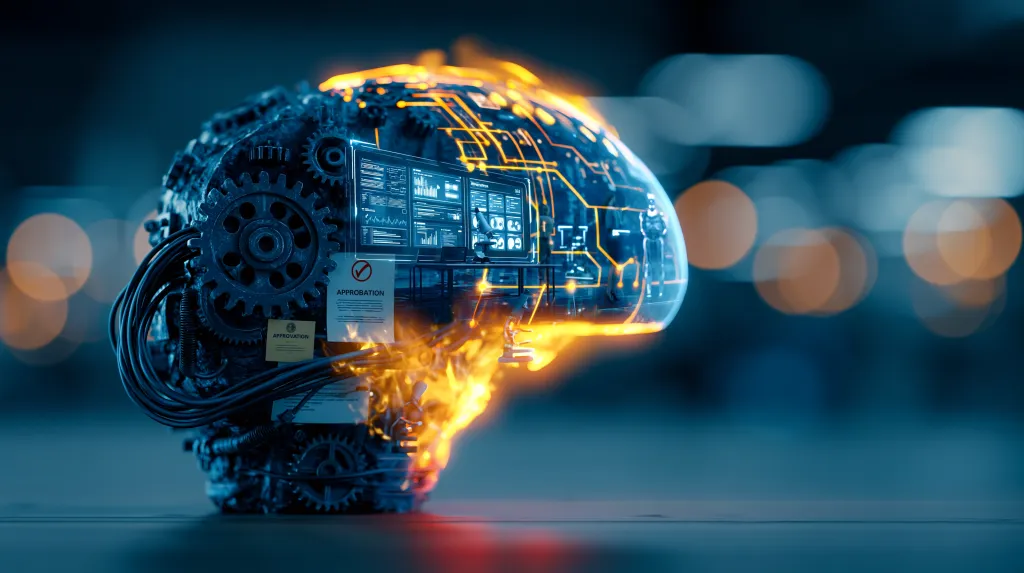
Productivity is not the same as progress
More output does not automatically mean better results.
In some cases, artificial intelligence can even add to the noise. More documents. More dashboards. More analysis. More messages. More versions. More initiatives.
The question for leaders isn't only whether the tools save time; it's what the company does with the time it frees up. Does it free people to focus on judgment, discernment, and higher-value work?
If the answer isn't clear, the company may be generating productivity without generating progress.
The new formula for innovation
Innovation in this era requires a more integrated formula.
Artificial intelligence matters, but it isn't enough.
Data matters, but waiting for perfect data can become an excuse.
Process redesign matters, but a redesign without adoption stays purely theoretical.
Talent matters, but training people on tools is not the same as preparing them for new roles.
Governance matters, but governance that only puts on the brakes ends up killing momentum.
Measurement matters, but measuring activity instead of impact creates false confidence.
The formula is technology, artificial intelligence, data, process redesign, talent, governance, adoption, customer thinking, and measurement, all working as one. Not as separate fronts, but as a single operating discipline.
Innovation can no longer live solely inside innovation departments. It cannot be fully delegated to technology. It cannot depend only on a handful of champions. It has to become part of the company's management system.
That is where innovation becomes real.
The next competitive advantage
The companies that win in this era will not necessarily be the ones running the most experiments.
It means turning artificial intelligence into capability, not just a tool. Turning pilots into repeatable models, productivity into performance, automation into redesigned work, data into decisions, and governance into trust.
In this revolution, technology hasn't just given us new capabilities, it has also compressed time.
What once took months to test can now be explored in days. What once required large teams can now start with small groups. What once seemed impossible now reaches operations far faster.
That is why the real question is no longer whether a company can generate innovation.
The question is whether it can absorb it at the speed it is now being produced.
Turning innovation into execution.
Ricardo Villanueva
Lead Partner, Innovation